I’ve always organised my life around movement.
Not as training, and not as escape, but as necessity. Long periods indoors dull my attention. Stillness without physical demand unsettles my thinking. Over time, I learned that my body is not something I carry with me — it is what anchors me in the world.
I chose work that kept me outside, exposed to weather and fatigue, because it required presence. I gravitated toward practices where attention could not drift without consequence — diving in open water, climbing, martial arts, time spent under weight or height or breath.
In these conditions, the margin for error is narrow.
When stakes are real, attention sharpens on its own. There is no space for abstraction. Movement resolves to what can be executed without excess or hesitation. Thought follows action rather than leading it. The body takes over, not through instinct alone, but through discipline built slowly, over repetition and correction.
What interests me is not adrenaline.
It’s the clarity that appears when distraction is removed.
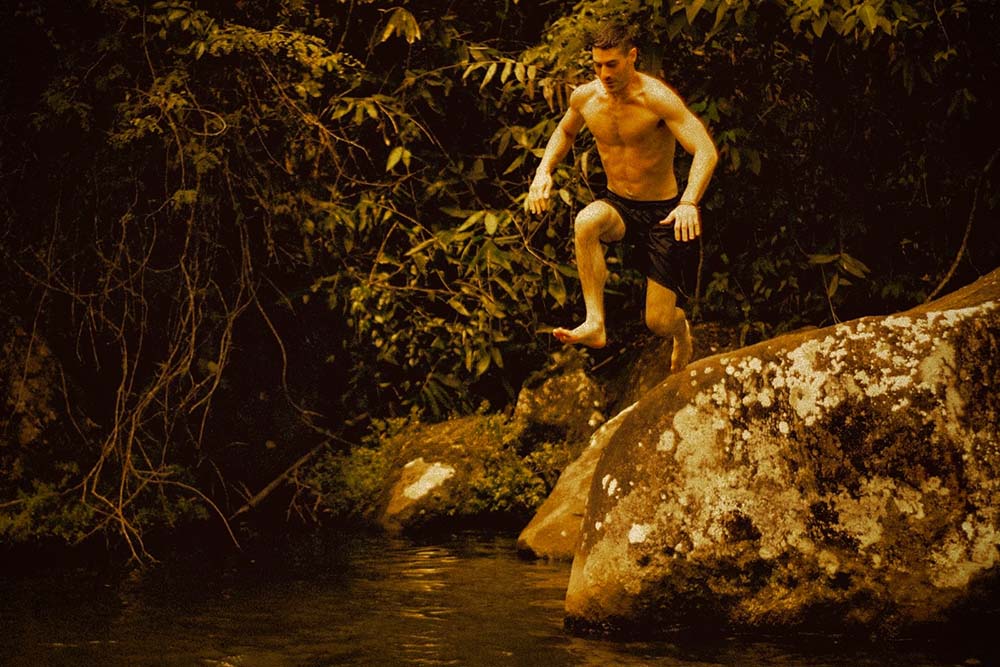
In jiu-jitsu, hesitation is immediately visible. In climbing, it’s punished without commentary. In water, it becomes dangerous. These environments do not teach in language. They reveal what has already been trained — and what has not.
Over time, I noticed something consistent.
My sense of capacity expands only when I’m willing to remain present where outcomes are uncertain. Not reckless exposure — but situations where responsibility cannot be deferred. Where attention matters because consequences are immediate.
There is no performance in these moments. Only conduct.
I don’t experience this as overcoming fear. Fear is incidental. What matters is whether I remain precise when precision is required. Whether I hold attention long enough for the body to respond correctly.
I return to these conditions because they strip away assumption.
They remove the illusion of safety that accumulates in daily life. They make capability legible again — not as confidence, but as something that must be earned repeatedly.
I still don’t know where my limits are.
I only know that they don’t reveal themselves in comfort, or in reflection alone. They appear when the body is required to act — and when attention is held long enough to see what remains.
That question stays open.